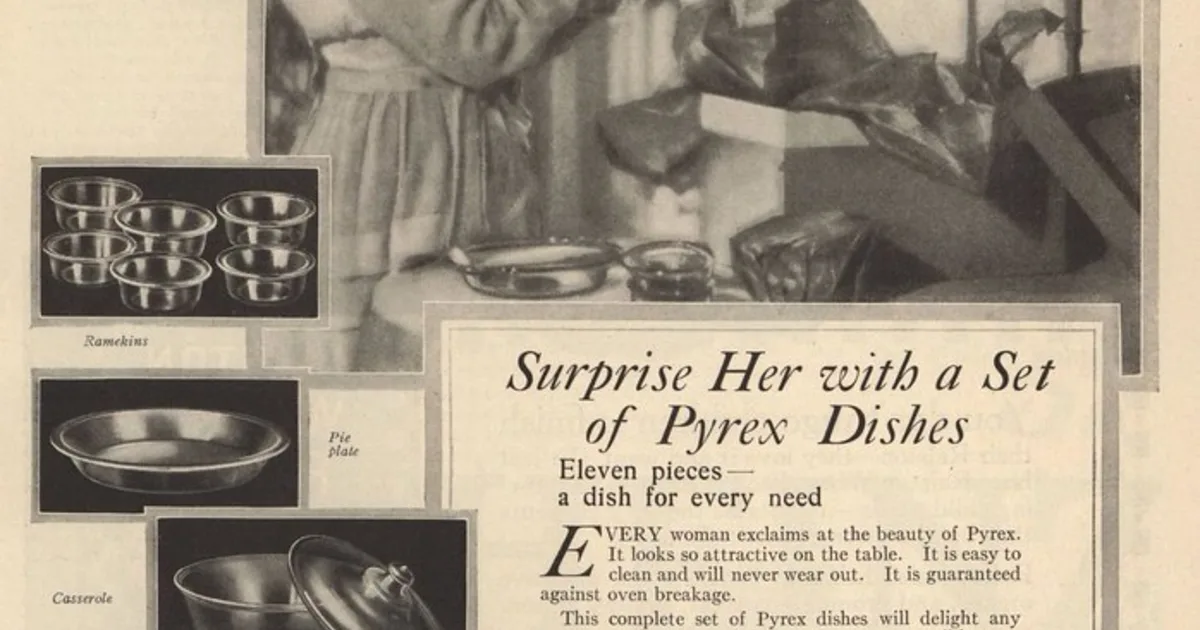
Pyrex has been made for more than a century, and the backstamp on the bottom of each piece changed enough over the decades to act as a built-in calendar. You will rarely get an exact year from the mark alone, but you can usually place a piece within a decade by combining the logo style, the wording, and any model number. This guide walks through each clue in the order a collector checks them.
Start with the logo style
The first thing to read is how the word Pyrex is written. Early American pieces use all capital letters, often inside a circle or with the registration wording around it. Mid-century pieces move to a cleaner rounded logo. Later pieces and the lowercase styling point to more recent decades. Note that British-made Pyrex, sold under a separate licence, uses a different logo and is dated by its own scheme, so confirm the country of origin before you compare marks.
Dating checklist
- Logo wordingRead whether it is all capitals, mixed case, or lowercase, and whether a registration mark or circle surrounds it.
- Country of originConfirm whether it reads made in USA or names another country. American and British Pyrex follow different mark histories.
- Model numberMatch the number stamped on the base to a published shape list. Numbers identify the exact bowl, dish, or casserole.
- Pattern eraCross-check the printed pattern. A pattern was only produced for a known window, which narrows the date further.
- Stamp methodNote whether the mark is molded into the glass or printed on. The method and its placement shifted over time.
A rough timeline of mark changes
The table below is a simplified reference for American-made Pyrex. Use it to place a piece in a decade, then confirm with the model number and pattern. The eras overlap at the edges, so treat boundaries as approximate.
| Era | Mark characteristics | Notes |
|---|---|---|
| Early | All-capital PYREX with registration wording | Often clear ovenware; circular stamp common |
| Mid-century | Capitals with "made in USA" and model number | Peak era for opal colour and pattern bowls |
| Later vintage | Cleaner logo, model number, pattern name | Wider colour range; printed patterns mature |
| Modern | Lowercase styling, current branding | Confirm against current maker materials |
Use the model number to pin the shape
The number stamped on the base is the most precise clue Pyrex gives you. Each casserole, mixing bowl, refrigerator dish, and lid carried its own model number, and those numbers map to specific shapes and sizes in published shape lists. Once you have read the number, you are no longer guessing at what the piece is. You know whether you are holding a particular round casserole or a nesting bowl from a known set, and that turns a vague description into a confident identification. The number also helps you spot mismatched lids, because a lid carries its own number that should pair with the base. When the base and lid numbers do not belong together, you are looking at a married set rather than an original pairing, which matters for both dating and value.
Cross-check the pattern era
Printed patterns are the other half of dating Pyrex, and they are often the most enjoyable clue to read. Each decorated pattern was produced for a known window of years, so identifying the pattern narrows the date independently of the backstamp. A piece whose stamp suggests one decade and whose pattern was only made later tells you the stamp era ran long, and the true date sits at the overlap. Promotional and short-run patterns are especially useful here because their narrow production windows can pin a piece tightly. Be careful with solid-colour pieces that carry no pattern at all, since they rely more heavily on the backstamp and shape number to date, and treat any pattern that looks unusually crisp or modern with the same caution you would give a reproduction in pottery.
Let the clues agree before you decide
No single feature dates a piece on its own. A backstamp might suggest one decade while the pattern points to another, which usually means the stamp era and pattern era overlap and the true date sits where they meet. When the logo style, the country of origin, the model number, and the pattern all agree, you can date a piece with confidence. When they conflict, trust the most specific evidence, which is normally the model number and pattern together.
This stacking approach is the same one used across kitchen collectibles. Once you can date a piece, you are better placed to value it, a process covered in our 2026 price guide, and to attribute pottery using the methods in our McCoy identification guide.